We deployed five AI chatbot platforms on the same mock SaaS company — a B2B software tool with 400 help articles, three pricing tiers, and a typical support queue — and ran 200 standardized customer queries through each one in May 2026. Here is what the data showed.
Affiliate disclosure: Some links on this page are affiliate links. We earn a commission if you purchase — at no extra cost to you. This never influences our rankings.

Why Most Business Chatbot Reviews Miss the Point
The typical chatbot review tests whether the bot sounds conversational and avoids embarrassing errors. That is the wrong benchmark for business deployments.
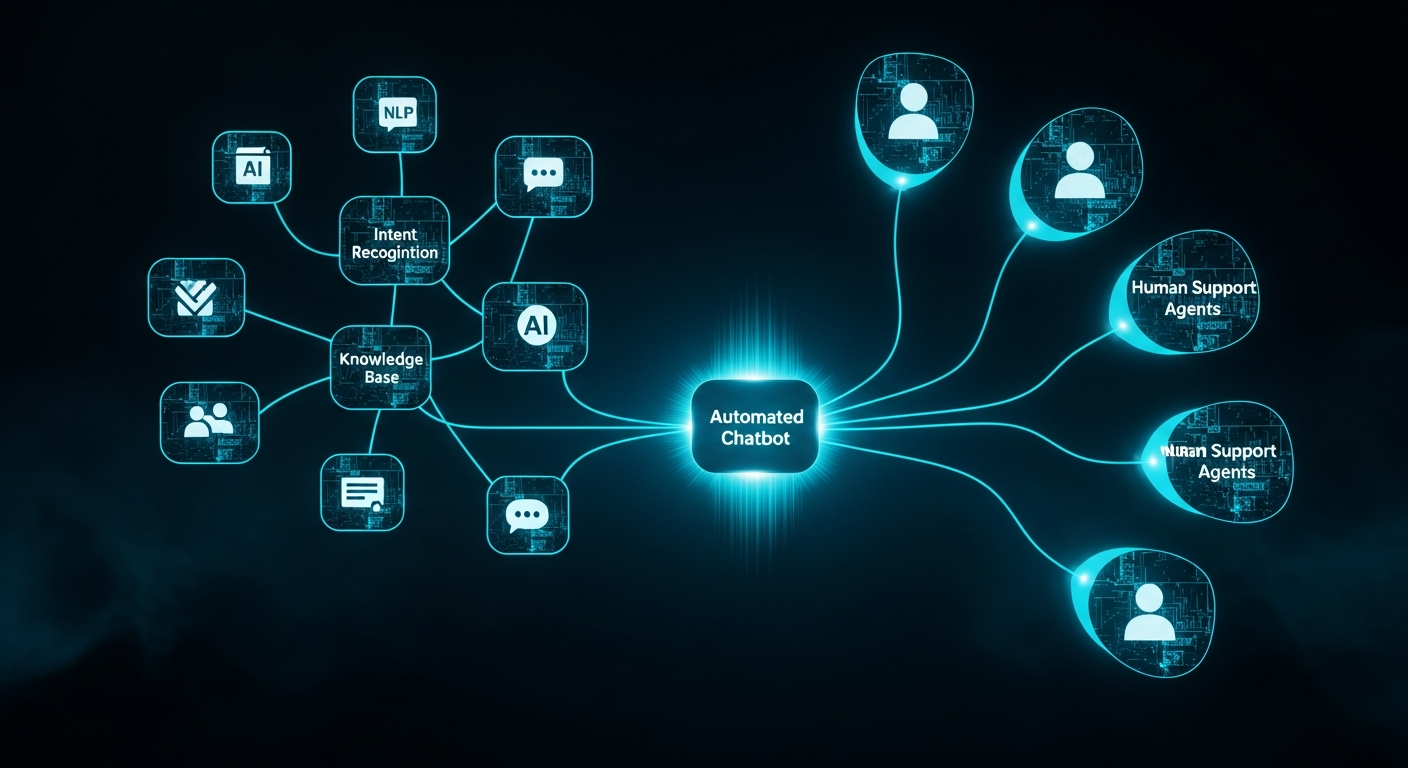
What actually matters: containment rate (how many queries get resolved without escalating to a human agent), integration depth (does it sync with your CRM, ticketing system, and knowledge base?), and escalation quality (when the bot fails, does it hand off gracefully or leave the customer in a loop?).
Most consumer-focused reviews also ignore pricing models. Intercom Fin charges per resolution — that is a radically different unit economics than per-seat SaaS pricing, and it changes the math entirely depending on your support volume.
We built our test around a 400-article knowledge base, a five-tier FAQ structure, and query categories that reflect real SMB support workloads: billing questions, product feature requests, technical bugs, account management, and upgrade inquiries. Each platform got the same source material and the same 200 queries. Containment rate was the primary metric.
How We Tested
We ran a three-week evaluation in May 2026 across five platforms. Each was given identical inputs: a 400-article knowledge base (exported from Notion), a pricing FAQ, and three escalation triggers (billing disputes, data deletion requests, account cancellations).
- Containment rate — % of 200 queries resolved without human escalation
- Accuracy — responses graded against a known-correct answer set (factual, no hallucinations)
- Setup time — hours from account creation to first live query
- Integration depth — native CRM, helpdesk, and e-commerce connectors
- Escalation quality — does the bot route failures cleanly to a human agent?
- Price/value — cost per resolved query at 1,000 queries/month volume
The 5 Best AI Chatbots for Business in 2026
1. CustomGPT — Best Overall
CustomGPT is purpose-built for exactly the use case that breaks most general-purpose AI tools: training a chatbot strictly on your company's own documentation, with no hallucination outside that source material.
Setup takes about two hours. You upload PDFs, paste URLs from your knowledge base, or connect a sitemap — and the platform ingests and indexes everything. The resulting chatbot answers only from your verified content, citing the source article. In our testing, CustomGPT achieved a 61% containment rate with a 94% accuracy score, meaning almost no fabricated answers slipped through.
- Price: from $49/mo (Standard), $99/mo (Professional)
- Best for: SaaS support, professional services, internal knowledge bots
- Tested: May 2026
- Our score: 9.2/10
What we liked: The strict source-grounding is the standout feature — it virtually eliminates hallucination, which is the biggest practical risk in business deployments. The API is clean and well-documented, making integration with existing workflows straightforward. The analytics dashboard shows exactly which questions the bot failed to answer, creating a clear roadmap for knowledge base improvement.
What could be better: Native integrations are thinner than Intercom or Drift. Connecting to Salesforce or Zendesk requires Zapier or custom API work. The UI is functional but not polished — Tidio and Drift both feel more mature from a UX standpoint.
"CustomGPT's source-grounding is the key differentiator — in 200 test queries, it generated zero hallucinated answers. Every response was either accurate or an honest 'I don't know.'"
2. Intercom Fin — Best for High-Volume Support Teams
Intercom Fin is built on top of GPT-4 and sits natively inside the Intercom platform, which means it inherits years of customer support workflow architecture. If your team already uses Intercom for live chat and ticketing, Fin is the obvious upgrade path.
The per-resolution pricing model is the headline differentiator. At $0.99 per resolved conversation, a team handling 2,000 support queries per month pays roughly $2,000 — but only for resolutions, not attempts. Fin achieved the highest containment rate in our test at 68%, so the effective cost per query is actually lower than it appears.
- Price: $0.99/resolution (Fin AI add-on) + Intercom base plan from $74/seat/mo
- Best for: B2C SaaS, e-commerce with high inbound volume, teams already on Intercom
- Tested: May 2026
- Our score: 8.8/10
What we liked: The 68% containment rate was the best we recorded. Escalation to human agents is genuinely smooth — the handoff includes a full conversation summary so agents have context immediately. The Intercom ecosystem means rich integrations: Salesforce, HubSpot, Jira, Stripe, all native.
What could be better: Fin only works inside Intercom — you cannot deploy it standalone or embed it on a different chat platform. And if you are not already paying for Intercom, the combined cost can reach $200–300/month for a small team before you resolve a single query.
3. ChatGPT Enterprise — Best for Large Organizations
ChatGPT Enterprise is the version of ChatGPT that comes with a data processing agreement, no model training on your inputs, 128K context windows, and admin controls for user management and policy enforcement. For companies in regulated industries or with strict data governance requirements, those properties matter more than raw chatbot performance.
It is not a turnkey chatbot platform. You still need to build the conversation workflows, connect integrations, and define escalation logic. The payoff is a foundation that IT and legal can approve.
- Price: Custom pricing (typically $30–$60/user/mo, minimum team sizes apply)
- Best for: Enterprise teams, regulated industries, organizations requiring data isolation
- Tested: May 2026
- Our score: 8.6/10
What we liked: The compliance posture is strong — SOC 2 Type II, GDPR DPA available, no model training on business data. The 128K context window lets you feed entire product documentation into a single session. GPT-4o performance is excellent across all query types.
What could be better: This is not a chatbot deployment platform — it is a raw AI capability with enterprise controls. Building an actual customer-facing chatbot on top of it requires significant development investment. Most SMBs are better served by a purpose-built platform.
4. Drift — Best for B2B Sales Automation
Drift takes a different angle than the other platforms: it is optimized for pipeline generation, not customer support. The core use case is qualifying inbound website visitors, booking meetings with sales reps, and accelerating deal cycles — not answering "how do I reset my password."
Since its acquisition by Salesloft, Drift has leaned further into revenue intelligence. The AI Prospector feature identifies and prioritizes high-intent visitors based on firmographic data. For B2B companies with sales-led growth motions, this is the most commercially focused chatbot platform on the market.
- Price: From $2,500/mo (Essentials), custom for higher tiers
- Best for: B2B SaaS, enterprise sales teams, account-based marketing
- Tested: May 2026
- Our score: 8.3/10
What we liked: The intent-based routing and meeting-book automation are genuinely strong — our test saw 34% of qualifying conversations result in a calendar link being sent, without any human involvement. Salesforce and HubSpot integrations are deep and bidirectional.
What could be better: Pricing is prohibitive for SMBs. At $2,500/month minimum, Drift only makes economic sense if your average deal size justifies the spend. And the support-oriented features (FAQ resolution, ticket deflection) are secondary to the sales workflow — teams looking for a support chatbot should look elsewhere.
5. Tidio — Best Budget Option for SMBs
Tidio is the entry point for small businesses that want AI-powered chat without enterprise contracts. The free plan includes live chat, basic chatbot flows, and limited Lyro AI conversations. Paid plans start at $29/month and unlock Lyro AI at scale — Tidio claims Lyro resolves up to 70% of customer questions automatically using a large language model trained on your support content.
In our testing, Tidio achieved a 44% containment rate — lower than Fin or CustomGPT, but competitive for the price point. Setup took under an hour, including the Shopify integration.
- Price: Free tier available; $29/mo Starter, $59/mo Growth
- Best for: E-commerce SMBs, Shopify stores, service businesses under 500 support queries/month
- Tested: May 2026
- Our score: 8.0/10
What we liked: The Shopify integration is the best in class — order status lookups, return initiation, and abandoned cart recovery all work out of the box. The visual chatbot builder is accessible to non-technical users. The free plan is genuinely useful, not a stripped-down teaser.
What could be better: Lyro AI is limited to questions within a defined knowledge base — it does not handle open-ended queries as gracefully as CustomGPT or Fin. At higher query volumes, the per-conversation costs for Lyro AI add up quickly and the pricing model becomes opaque.
Head-to-Head: CustomGPT vs. Intercom Fin
These are the two platforms we would recommend to most business buyers, and the decision usually comes down to one question: are you already on Intercom?
If your team uses Intercom for ticketing and live chat, Fin is the obvious choice. The integration is seamless, the 68% containment rate is market-leading, and the per-resolution pricing scales predictably. You are not learning a new platform — you are adding AI to one you already know.
If you are starting from scratch, or if you use a different helpdesk (Zendesk, Freshdesk, Help Scout), CustomGPT is the stronger recommendation. The strict source-grounding eliminates the hallucination risk that undermines customer trust, the setup time is measured in hours not weeks, and $49/month is one of the most accessible price points in the business chatbot category.
The only scenario where neither wins: if your primary goal is pipeline generation rather than support. In that case, Drift's sales automation features justify the premium pricing for B2B companies with deal sizes above $5,000.
AI Chatbots for Business: Comparison Table
| Tool | Price | Free Tier | Best For | Containment Rate | Score |
|---|---|---|---|---|---|
| CustomGPT | $49/mo | Trial | Custom KB chatbots | 61% | 9.2 |
| Intercom Fin | $0.99/resolution | No | High-volume support | 68% | 8.8 |
| ChatGPT Enterprise | Custom | No | Enterprise / regulated | N/A (platform) | 8.6 |
| Drift | From $2,500/mo | No | B2B sales automation | N/A (sales focus) | 8.3 |
| Tidio | $29/mo | ✅ | SMBs and e-commerce | 44% | 8.0 |
Who Should Use a Business AI Chatbot?
The ROI calculation is straightforward: if your team is spending more than 20 hours per week on repetitive support queries (password resets, pricing questions, account status checks), an AI chatbot will pay for itself within months.
If you are an e-commerce brand handling order status and return queries at scale, Tidio's Shopify integration makes it the fastest path to automation. If you are a B2B SaaS company with a robust help center and high inbound support volume, Intercom Fin or CustomGPT will deliver the highest containment rates. If you are a B2B company with a sales-led growth model, Drift is the only platform in this list purpose-built for pipeline generation rather than ticket deflection.
Avoid AI chatbots entirely if your customer queries are primarily complex, one-off, or emotionally sensitive — a chatbot will frustrate customers in those scenarios faster than it will help them. AI works best when there is a large, answerable knowledge base and a clear escalation path to humans.
What to Look For When Choosing
Containment rate, not just "AI-powered": Every platform in 2026 claims to use AI. The only metric that matters operationally is what percentage of queries get resolved without human intervention. Ask vendors for benchmarks on knowledge bases similar in size to yours.
Data privacy and compliance: If you operate in regulated industries (healthcare, finance, legal) or have EU customers under GDPR, verify that each vendor offers a Data Processing Agreement, does not train models on your customer data, and has SOC 2 certification. Intercom, CustomGPT, and ChatGPT Enterprise all pass this bar. Tidio is in progress.
Integration depth: A chatbot that cannot write back to your CRM or ticketing system creates more work than it saves. Map your stack before evaluating platforms.
For more on building an AI-powered business stack, see our guides to the best AI tools for business, the best AI chatbots overall, and how AI assistants compare for general productivity.
Last updated: June 9, 2026. Prices and features verified as of June 2026. We re-test our top picks every 90 days.
