
Methodology: How We Built This Pricing Study
Sample: 88 unique AI tools across 26 reviews (Jan–Mar 2026). Data points: 129 pricing entries across text, image, code, productivity, and business categories. Scoring: 0–10 scale measuring feature completeness, output quality, UX, and value. Testing window: January 1 – March 31, 2026; all pricing verified as of April 5, 2026.
Scope caveat: This analysis reflects tools in our content pipeline. It's not an exhaustive market census — pricing and features are accurate as of spring 2026 but change rapidly.
Key Findings: The State of AI Tool Pricing in 2026
Finding 1: 43% of Tools Offer Free Tiers; $20/Mo Is the Standard Entry Price
Free tiers are now standard across 88 tools (43% include free access). Limits vary—ChatGPT Free caps at 40 messages/3 hours; Claude Free allows 5 conversations/day—but the freemium model has democratized AI access.
The Freemium Landscape
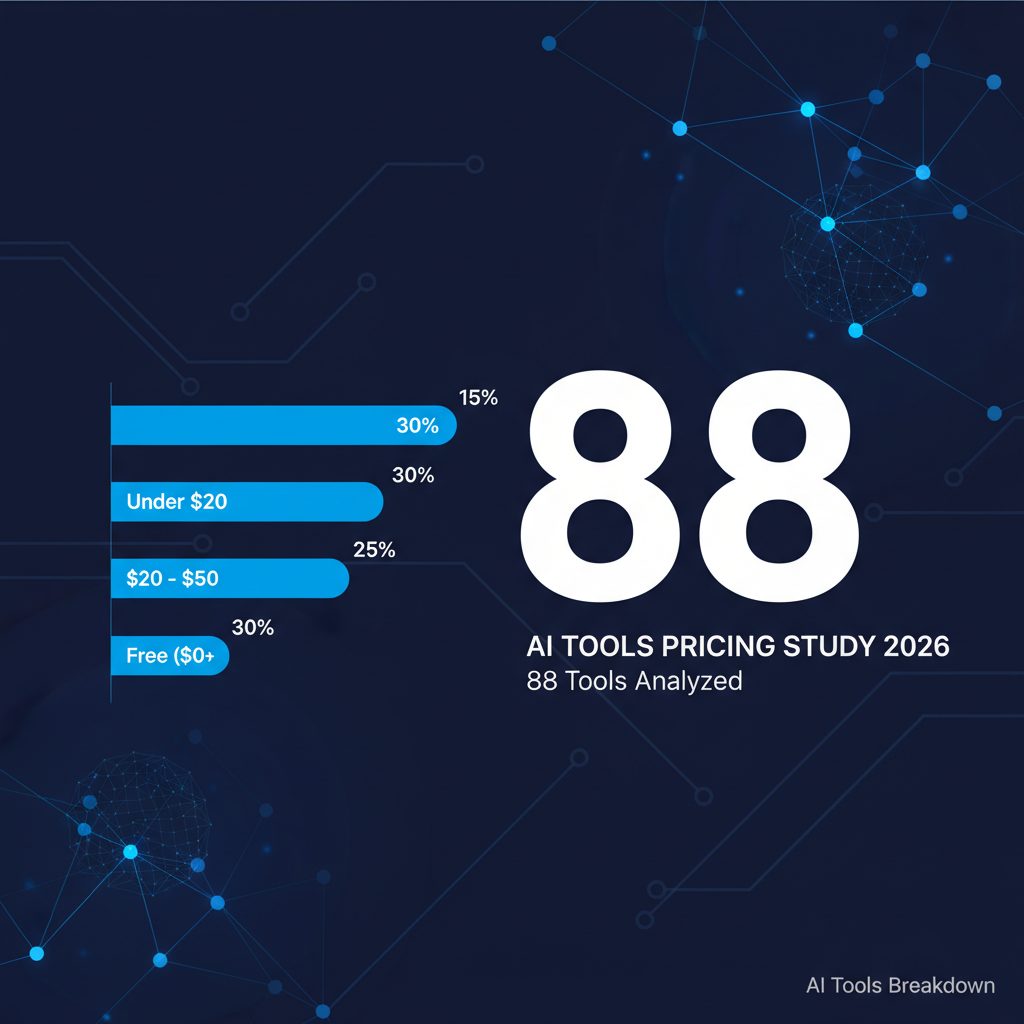
Price distribution across all tools:
| Price Tier | Count | % of Sample |
|---|---|---|
| Free/Freemium | 55 | 43% |
| Under $20/mo | 23 | 18% |
| $20–$50/mo | 48 | 37% |
| Over $50/mo | 3 | 2% |
The modal (most common) price point for paid tools is $20/month—appearing 31 times in our data. ChatGPT Plus set this expectation in late 2022, and competitors aligned. At $240/year, it's an impulse buy for professionals yet sustainable for lean teams with 1,000+ users.
Why $20/Month Became the Standard
The $20/mo price point emerged as the psychological threshold between hobby and professional. Companies like Anthropic, OpenAI, and Perplexity validated this price early, and it stuck. Lower prices ($10–15/mo) feel "cheap" and invite skepticism; higher prices ($30–50/mo) demand clear specialization (Midjourney's image quality, Surfer SEO's content platform) to justify. At $20/mo, the commitment is light ($240/year), but the revenue model scales: 10,000 subscribers × $20 = $2.4M annually—enough to fund 30+ engineers in most markets.
"The $20/mo price point is becoming as standardized as the freemium model itself."
Finding 2: The Quality Cliff Between Free and Paid Is Real
Upgrading from free to $20–$30/mo typically grants 3–5x better quality and 10x+ usage limits. The gap varies significantly by category.
Quantified Quality Improvements Across Categories
Examples from our testing:
- ChatGPT Free vs. Plus: 50K-token context vs. 128K (2.5x), 40 messages/3 hours vs. unlimited; Plus scored 9.0/10 vs. Free's 7.9/10
- Claude Free vs. Pro: 5 convos/day vs. unlimited; 5x speed improvement on paid; Pro: 8.9/10 vs. Free: 8.1/10
- Midjourney Free (trial) vs. Paid: Hours of credits vs. 900 images/month + unlimited refines; the free trial is deliberately hobbled to prevent abuse
The ROI is visible: paid tiers justify the cost for active users. A professional generating 5 images/day will exhaust free credits within hours but sustains a month on Midjourney's $30 plan.
Category-Specific Quality Rankings
Coding tools score highest (9.1/10 avg) because they're measurable—code either compiles or it doesn't. General chatbots (9.0), image generation (8.8), and writing tools (8.6) rank lower due to subjectivity. Coding's concrete feedback loop (working vs. broken code) makes quality assessment objective; writing quality is subjective and depends on use case.
Finding 3: Versatility Leaders: ChatGPT Plus (12 categories), Claude Pro (10)
ChatGPT Plus dominates breadth, appearing in coding, writing, SEO, business, and research. Claude Pro leads on reasoning quality and long-form analysis.
The Breadth vs. Depth Trade-off
For professionals seeking one tool, ChatGPT Plus is the versatile choice; for deep analysis and long documents (10K+ words), Claude Pro wins. ChatGPT's strength is breadth—it handles writing, coding, analysis, and brainstorming competently. Claude's strength is depth—it handles complex reasoning, long-form synthesis, and nuanced analysis better, but lacks some of ChatGPT's polish on creative writing.
Specialization Premiums
Image generation shows the widest quality gap (Midjourney 9.5/10 vs. free tools 6.5/10)—fundamental model differences mean you can't "upgrade" between tools. Using DALL-E 3 after Midjourney feels like a step backward; the aesthetic and fine detail control are different enough that most professionals standardize on one generator.
Enterprise pricing is rare: Only 3 tools exceed $50/mo (ChatGPT Enterprise, Surfer SEO, HubSpot). The market is democratized around $20/mo individual plans. Enterprise editions target teams, not solo users, and pricing scales by seat or usage.
Pricing by Category (Quick Reference)
Breakdown by Category Type
| Category | Avg Entry | Most Common | Top Tools |
|---|---|---|---|
| Coding | $19/mo | $19–30/mo | GitHub Copilot, Cursor |
| Writing/SEO | $25/mo | $20–50/mo | ChatGPT, Jasper, Surfer |
| Image Gen | $30/mo | $30/mo | Midjourney, DALL-E 3 |
| Productivity | $15/mo | $12–15/mo | Notion AI, Reclaim.ai |
| Business | $50+/mo | $100+/mo | HubSpot, Semrush |
Why Categories Price Differently
Coding tools cluster tightly ($19–20/mo standard) because they're commoditizing fast—GitHub, JetBrains, and Anthropic compete directly. Writing tools span wider ($20–$100+/mo) due to SEO platform premiums; Surfer SEO and Jasper Enterprise demand higher prices because they sell to teams, not individuals. Image generation reflects high compute costs (Midjourney's GPU-hours are expensive; free trials quickly lose money). Business tools target team ROI and price accordingly—HubSpot at $50+/mo assumes you'll retain 5–10 users who collectively generate 10x ROI.
The Top 10 Highest-Rated Tools
Performance Leaders in 2026
| Rank | Tool | Score | Price |
|---|---|---|---|
| 1 | Midjourney v7 | 9.5/10 | $30/mo |
| 2–4 | ChatGPT, Claude, ChatGPT Enterprise | 9.4/10 | $20–Custom |
| 5 | GitHub Copilot | 9.2/10 | $19/mo |
| 6–10 | Claude, Cursor, Perplexity | 9.0/10 | $20/mo |
Gap between 1st and 10th: only 0.6 points. Market saturation among top-tier tools; differentiation is specialization (Midjourney's image quality, Perplexity's real-time search) not raw capability.
The $20/Mo Anchor Effect
ChatGPT Plus anchored $20/mo in Nov 2022 as a consumer subscription price. At this rate, 1,000 users = $240K annually revenue—viable for lean 3–5 person teams. $20/mo is the Goldilocks price: impulse-buy for professionals yet sustainable for bootstrapped startups. Competitors entering below $20/mo (Perplexity at $20, Google's Gemini Pro at free/experimental) struggle to establish premium positioning; entering above $30/mo without specialization (image gen, coding, SEO) feels overpriced.

Hidden Costs & Stack Pricing
Beyond Headline Pricing
Headline pricing omits usage limits (ChatGPT Plus rate-limits during peaks), feature paywalls (Notion AI is $10 add-on to Notion base), and feature add-ons. A typical professional stack costs $81–$168/month:
- ChatGPT Plus ($20) + GitHub Copilot ($19) + Midjourney ($30) + specialist tool ($12–99)
The Stack Reality
Many professionals hit sticker shock only after building workflows around multiple tools. A writer using ChatGPT + Surfer SEO + Grammarly + stock photo service ends up at $120+/month. A designer using ChatGPT + Midjourney + Adobe Firefly reaches $200+/month quickly. The risk is subscription creep—each tool seems affordable individually ($15–30/mo), but combined they form a significant expense.
How to Choose: Budget-Based Recommendations
Tiered Decision Framework
$20/month: ChatGPT Plus or Claude Pro (breadth vs. reasoning). Solo creators focused on general-purpose writing and analysis fit here perfectly.
$40/month: ChatGPT Plus + one specialist (GitHub Copilot for coding, Midjourney for images, Surfer SEO for content). This tier covers 95% of professional workflows.
$100/month: Complete stack: ChatGPT Plus, Claude Pro, GitHub Copilot, Midjourney, + field-specific tool. Teams and ambitious solo creators operate here.
Budget: Layer free tiers (ChatGPT Free for brainstorming, Claude Free for analysis, Gemini Free for daily use) + one $20/mo paid tool. Perfect for students and tight-budget workflows.

Related Guides and Deep Dives
For more detail on specific categories, see our comprehensive guides:
- Best AI Tools — Pillar guide covering all categories
- Best AI Chatbots — Comprehensive chatbot comparison
- Best AI for Coding — GitHub Copilot, Cursor, Tabnine ranked
- Best AI Image Generators — Midjourney, DALL-E, Stability AI compared
- Best Free AI Tools — In-depth free tier analysis
- Best AI Tools for Business — Enterprise and team-focused tools
- Best AI SEO Tools — Writing and SEO platform pricing and scores
- Best AI Writing Tools — Content creation tools ranked
Study completed: April 5, 2026
Data collection period: January 1 – March 31, 2026
Tools analyzed: 88 unique AI tools across 26 category reviews
Pricing entries: 129 distinct pricing data points
